

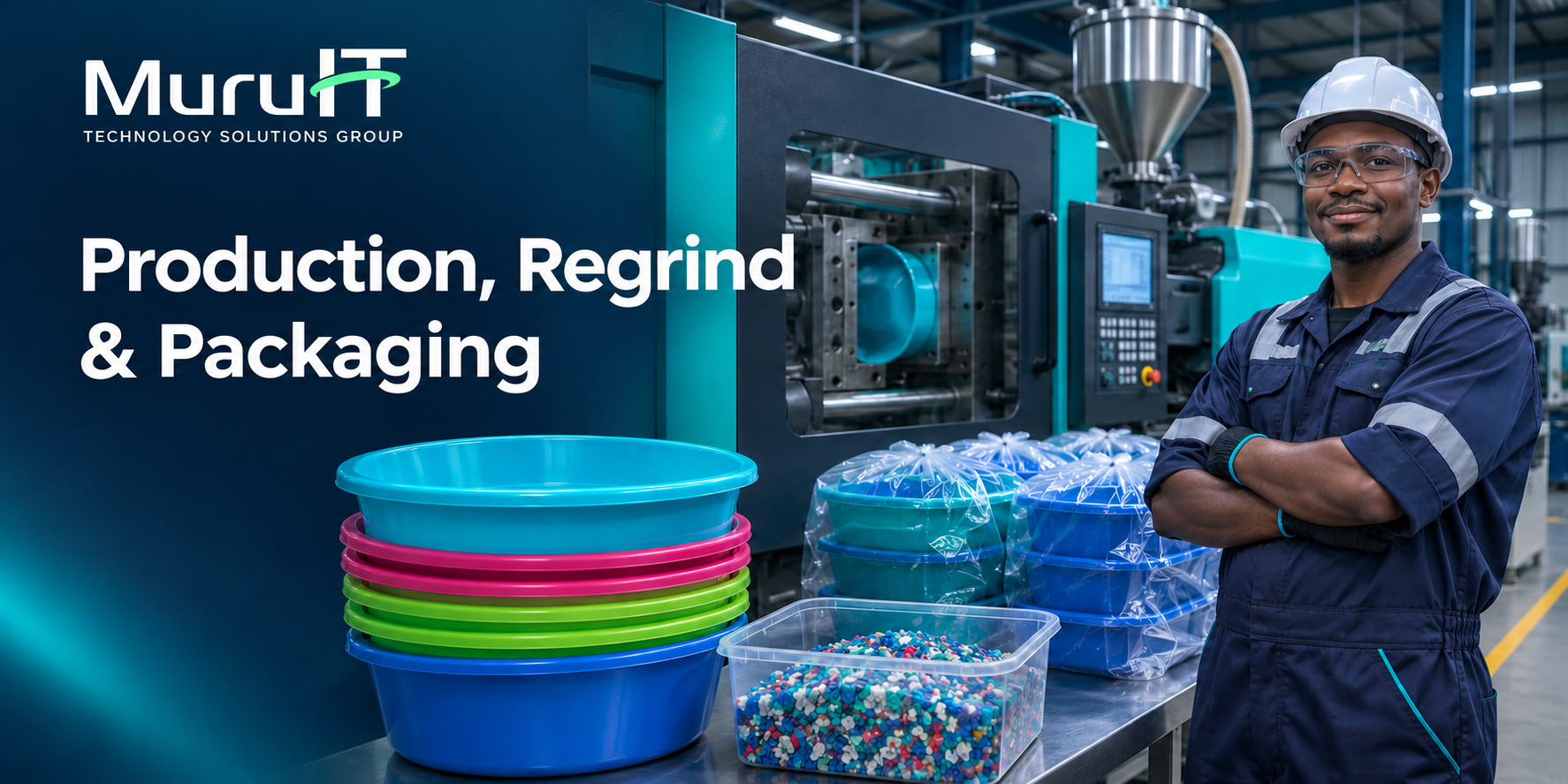

A plastics production record needs to explain more than the number of items made. It should connect the material issued, the machine used, the acceptable output, rejected pieces and packaged stock. When those records sit in separate books, supervisors have to reconstruct the batch before they can understand its cost.
Separate the recipe from actual production
The recipe describes the planned inputs and expected yield. A production entry records what actually happened. Keep both so the team can compare planned material use with actual consumption without changing the original expectation after every run.
Give each run a batch reference and record its product, machine, date, responsible operator and production time. Link the materials issued to that reference. If production continues across shifts, retain the entries that show when and by whom output was recorded.
Record acceptable and rejected output
Capture total pieces produced and the number accepted after inspection. Record faulty pieces separately, with a reason where practical. A reject count shows how many pieces failed inspection. A weight recorded during regrinding shows how much recoverable material was obtained. Keep those measurements distinct.
Make recovered material traceable
Record the source batch, material type, colour and recovered weight. Where material is mixed or cannot be linked to one batch, record that explicitly. Store the recovered quantity as identifiable stock before issuing it to another production run.
Treat packaging as the final stock step
Record how many acceptable pieces become packaged units. If one basin type uses a different number of pieces per bundle, define that conversion against the product. Check how the system handles a partially filled bundle and loose pieces so physical stock can be reconciled.
Review costs with the quantities
Bring actual material consumption, agreed labour allocation, machine costs and packaging inputs into the costing method. Define how rejected output and recovered material affect cost so comparisons between batches use the same rules. A unit cost should show which costs and quantity it uses.
Muru Technologies’ manufacturing systems work includes production recording, inventory, material recovery and reporting. We help teams turn these connected steps into a workflow they can follow from recipe to packaged stock.
SUBSCRIBE BELOW TO GET MORE UPDATES


